• Sort Array by Parity – Java

    This solution runs in 0(n) time (linear) and uses O(1) space (constant) and is based on the Dutch National Flag Problem.

    class Solution {
        public int[] sortArrayByParity(int[] A) {
            int low = 0, mid = 0, high = A.length - 1;
            int temp;
            while (mid <= high) {
                if (A[mid] == 0) {
                    temp = A[mid];
                    A[mid] = A[low];
                    A[low] = temp;
                    low++;
                    mid++;
                } else if (A[mid] % 2 == 0) {
                    mid++;
                } else {
                    temp = A[mid];
                    A[mid] = A[high];
                    A[high] = temp;
                    high--;
                }
            }
            return A;
        }
    }
     

  • Two Sum

    Optimized for runtime.
    Time O(n)
    Memory O(n)

    class Solution {
        public int[] twoSum(int[] nums, int target) {
            int[] ret = new int[2];
            HashMap < Integer, Integer > map = new HashMap < Integer, Integer > ();
            for (int i = 0; i < nums.length; i++) {
                if (map.get(nums[i]) != null) {
                    ret[0] = map.get(nums[i]);
                    ret[1] = i;
                    return ret;
                }
                map.put(target - nums[i], i);
            }
            return ret;
        }
    }
  • Search in Rotated Sorted Array

    Solution uses a modified version of Binary Search.
    Javascript (ES6)

    /**
     * @param {number[]} nums
     * @param {number} target
     * @return {number}
     */
    const search = (nums, target) => {
      let low = 0;
      let high = nums.length - 1;
      while (low <= high) {
        const mid = low + Math.floor((high - low) / 2);
        if (nums[mid] === target) {
          return mid;
        }
        if (nums[low] <= nums[mid]) {
          // Left half is sorted.
          if (target >= nums[low] && target < nums[mid]) {
            high = mid - 1;
          } else {
            low = mid + 1;
          }
        } else {
          // Right half is sorted.
          if (target > nums[mid] && target <= nums[high]) {
            low = mid + 1;
          } else {
            high = mid - 1;
          }
        }
      }
      return -1;
    };
    
    console.log(search([4, 5, 1, 2, 3], 2)); // 3
    

    Demo

    Java

    Time: O(nlogn)
    Space: O(1)

    class Solution {
     public int search(int[] nums, int target) {
      int low = 0, high = nums.length - 1;
      int mid;
      while (low <= high) {
       mid = low + (high - low) / 2;
       if (nums[mid] == target)
        return mid;
       else if (nums[mid] < nums[high]) {
        if (target > nums[mid] && target <= nums[high])
         low = mid + 1;
        else
         high = mid - 1;
       } else {
        if (target >= nums[low] && target < nums[mid])
         high = mid - 1;
        else
         low = mid + 1;
       }
      }
      return -1;
     }
    }
  • String to Integer (atoi) – Java

    class Solution {
     public int myAtoi(String str) {
      int ret = 0;
      int i = 0;
      boolean negative = false;
      String retString = "";
      // Without using trim()
      // while(i<str.length() && str.charAt(i) == ' ')
      //     i++;
      str = str.trim();
      if (i >= str.length() || Character.isLetter(str.charAt(i)))
       return ret;
      if (str.charAt(i) == '-') {
       negative = true;
       i++;
      } else if (str.charAt(i) == '+') {
       i++;
      }
      while (i < str.length() && Character.isDigit(str.charAt(i))) {
       retString += str.charAt(i++);
      }
      if (retString != "") {
       try {
        ret = (negative ? -1 * Integer.parseInt(retString) : Integer.parseInt(retString));
       } catch (Exception e) {
        ret = (negative ? Integer.MIN_VALUE : Integer.MAX_VALUE);
       }
      }
      return ret;
     }
    }
    
  • Merge Intervals

    Javascript (ES6)

    /**
     * @param {number[][]} intervals
     * @return {number[][]}
     */
    const merge = (intervals) => {
      intervals.sort((a, b) => a[0] - b[0]);
      const ret = [];
      let prev = null;
      for (const interval of intervals) {
        if (prev != null) {
          if (interval[0] > prev[1]) {
            ret.push(prev);
            prev = interval;
          } else {
            // Merge case.
            prev[1] = Math.max(interval[1], prev[1]);
          }
        } else {
          prev = interval;
        }
      }
      if (prev !== null) {
        ret.push(prev);
      }
      return ret;
    };
    
    console.log(merge([
      [1, 3],
      [2, 6],
      [8, 10],
      [15, 18]
    ])); // [[1,6],[8,10],[15,18]]
    

    Demo

    If  “n” is the length of the input list, then the “Time Complexity”  is O(nlogn).

    /**
     * Definition for an interval.
     * public class Interval {
     *     int start;
     *     int end;
     *     Interval() { start = 0; end = 0; }
     *     Interval(int s, int e) { start = s; end = e; }
     * }
     */
    
    class Solution {
     public List < Interval > merge(List < Interval > intervals) {
      // Sort the input list by the start times.
      Collections.sort(intervals, (a, b) -> a.start - b.start);
      List < Interval > ret = new ArrayList < Interval > ();
      Interval prev = null;
      for (Interval curr: intervals) {
       if (prev == null) {
        prev = curr;
       } else {
        if (curr.start <= prev.end) {
         prev.end = Math.max(curr.end, prev.end);
        } else {
         ret.add(prev);
         prev = curr;
        }
       }
      }
      if (prev != null) {
       ret.add(prev);
      }
      return ret;
     }
    }
  • Product of Array Except Self – Java

    Time – O(n)
    Space – 0(1)  – Neglecting the output array that is expected to be returned.

    class Solution {
     public int[] productExceptSelf(int[] nums) {
      int n = nums.length;
      int[] output = new int[n];
      int temp = 1;
      // product from left to right excluding nums[i]
      for (int i = 0; i < n; i++) {
       output[i] = temp;
       temp *= nums[i];
      }
      temp = 1;
      // product from right to left excluding nums[i]
      for (int i = n - 1; i >= 0; i--) {
       output[i] *= temp;
       temp *= nums[i];
      }
      return output;
     }
    }
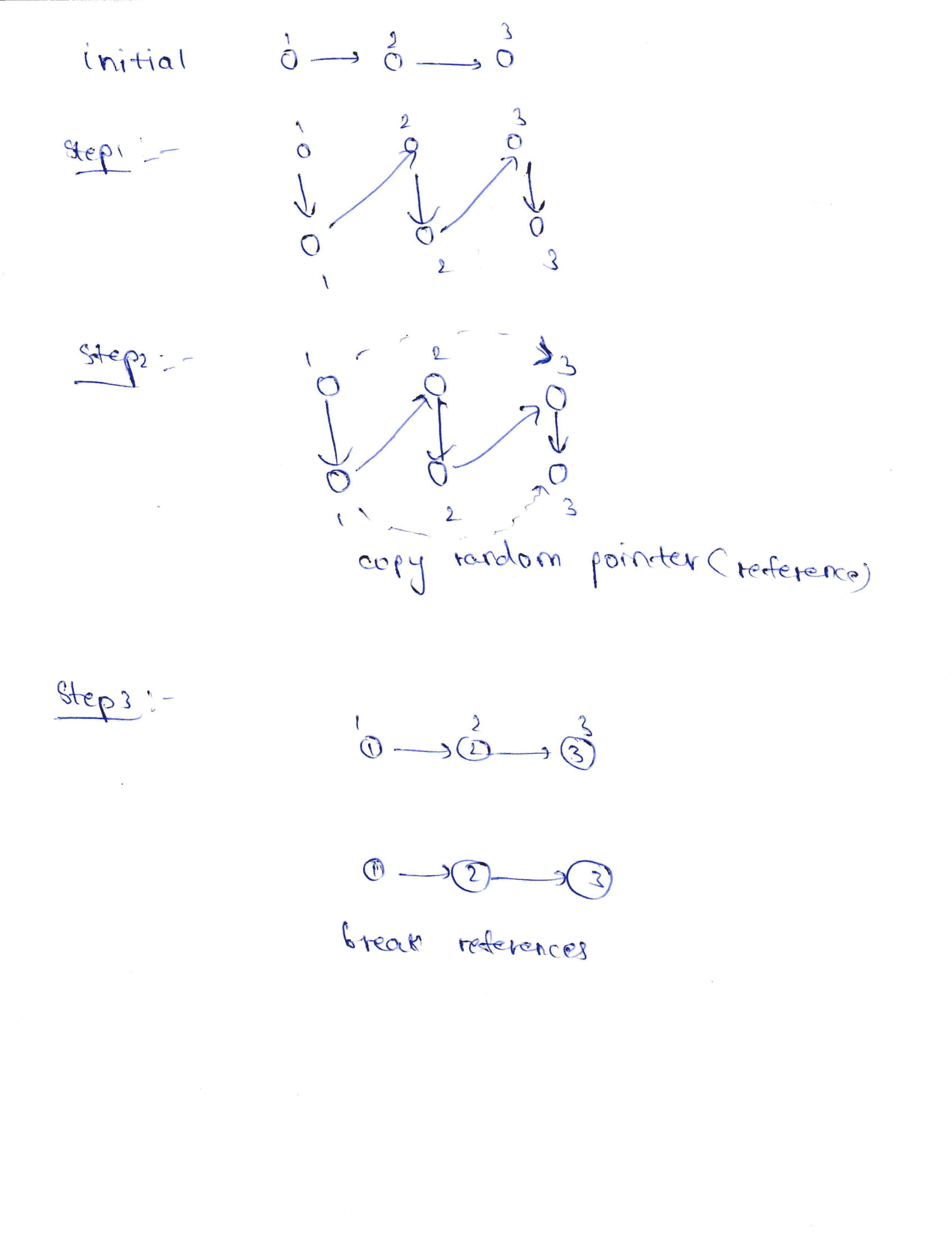
  • Copy List with Random Pointer (Reference) – Java

    This method doesn’t use a HashMap.

    Copy List with Random Pointer

    /**
     * Definition for singly-linked list with a random pointer.
     * class RandomListNode {
     *     int label;
     *     RandomListNode next, random;
     *     RandomListNode(int x) { this.label = x; }
     * };
     */
    public class Solution {
     public RandomListNode copyRandomList(RandomListNode head) {
      if (head == null)
       return null;
      // Step 1 - Store copy in next
      RandomListNode n = head;
      while (n != null) {
       RandomListNode c = new RandomListNode(n.label);
       c.next = n.next;
       n.next = c;
       n = c.next;
      }
      // Step 2 - Copy Random reference
      n = head;
      while (n != null) {
       if (n.random != null) {
        n.next.random = n.random.next;
       }
       n = n.next.next;
      }
      // Step 3 - Break references
      n = head;
      RandomListNode ret = head.next;
      while (n != null) {
       RandomListNode copy = n.next;
       n.next = copy.next;
       if (n.next != null) {
        copy.next = n.next.next;
       }
       n = n.next;
      }
      return ret;
     }
    }


  • Flatten Binary Tree to Linked List – Java

    /**
     * Definition for a binary tree node.
     * public class TreeNode {
     *     int val;
     *     TreeNode left;
     *     TreeNode right;
     *     TreeNode(int x) { val = x; }
     * }
     */
    class Solution {
     public void flatten(TreeNode root) {
      moveLeftToRight(root);
     }
    
     public TreeNode moveLeftToRight(TreeNode root) {
      if (root == null)
       return null;
      TreeNode last = null;
      TreeNode right = root.right;
      if (root.left != null) {
       root.right = root.left;
       root.left = null;
       last = moveLeftToRight(root.right);
       last.right = right;
      }
      if (right != null) {
       last = moveLeftToRight(right);
      }
      return (last != null ? last : root);
     }
    }
    
  • 3Sum

    Time O(n2) & Memory O(1)

    class Solution {
     public List < List < Integer >> threeSum(int[] nums) {
      int n = nums.length;
      List < List < Integer >> list = new ArrayList < List < Integer >> ();
         if(nums == null || nums.length<3)
            return list;
      Arrays.sort(nums);
      int left, right;
      for (int i = 0; i < n - 2; i++) {
       if(i > 0 && nums[i] == nums[i-1])
           continue;
       left = i + 1;
       right = n - 1;
       while (left < right) {
        if (nums[left] + nums[right] + nums[i] == 0) {
         List < Integer > temp = new ArrayList < Integer > ();
         temp.add(nums[i]);
         temp.add(nums[left]);
         temp.add(nums[right]);
         list.add(temp);
         left++;
         right--;
         while (nums[left] == nums[left - 1]) {
          left++;
         }
         while (left< right && nums[right] == nums[right + 1]) {
          right--;
         }
        } else if (nums[left] + nums[right] + nums[i]  > 0) {
         right--;
        } else
         left++;
       }
      }
      return list;
     }
    }

    Javascript ES6

    const get3Sum = (arr) => {
      const results = [];
      arr.sort((a, b) => a - b);
      for (let i = 0; (i < arr.length - 2) && (arr[i] <= 0); i++) {
        if (i === 0 || arr[i] !== arr[i - 1]) {
          getPair(arr, i, results);
        }
      }
      return results;
    };
    
    const getPair = (arr, i, results) => {
      let left = i + 1;
      let right = arr.length - 1;
      while (left < right) {
        const sum = arr[i] + arr[left] + arr[right];
        if (sum === 0) {
          results.push([arr[i], arr[left++], arr[right--]]);
          while (arr[left - 1] == arr[left]) {
            left++;
          }
        } else if (sum < 0) {
          left++;
        } else if (sum > 0) {
          right--;
        }
      }
    };
    
    console.log(get3Sum([-1, 0, 1, 2, -1, -4]));
    // [[-1 , 0, 1], [-1, -1, 2]]

    Demo

  • Trapping Rain Water

    Javascript (ES6)

    /**
     * @param {number[]} height
     * @return {number}
     */
    const trap = function(height) {
      const left = [];
      const right = [];
      let lmax = height[0];
      let rmax = height[height.length - 1];
      for (let i = 0; i < height.length; i++) {
        if (height[i] > lmax) {
          lmax = height[i];
        }
        left[i] = lmax;
        let j = height.length - i - 1;
        if (height[j] > rmax) {
          rmax = height[j];
        }
        right[j] = rmax;
      }
      let total = 0;
      for (let i = 0; i < height.length; i++) {
        total += Math.abs(height[i] - Math.min(left[i], right[i]));
      }
      return total;
    };
    
    console.log(trap([0, 1, 0, 2, 1, 0, 1, 3, 2, 1, 2, 1])); // 6
    

    Demo

    Java

    Time: O(n)
    Memory: O(n)

    
    class Solution {
     public int trap(int[] height) {
      int n = height.length;
      if (n == 0)
       return 0;
      int[] left = new int[n];
      int[] right = new int[n];
      left[0] = height[0];
      right[n - 1] = height[n - 1];
      int j;
      for (int i = 1; i < n; i++) {
       left[i] = Math.max(left[i - 1], height[i]);
       right[n - i - 1] = Math.max(right[n - i], height[n - i - 1]);
      }
      int area = 0;
      for (int i = 1; i < n - 1; i++) {
       area += Math.min(left[i], right[i]) - height[i];
      }
      return area;
     }
    }